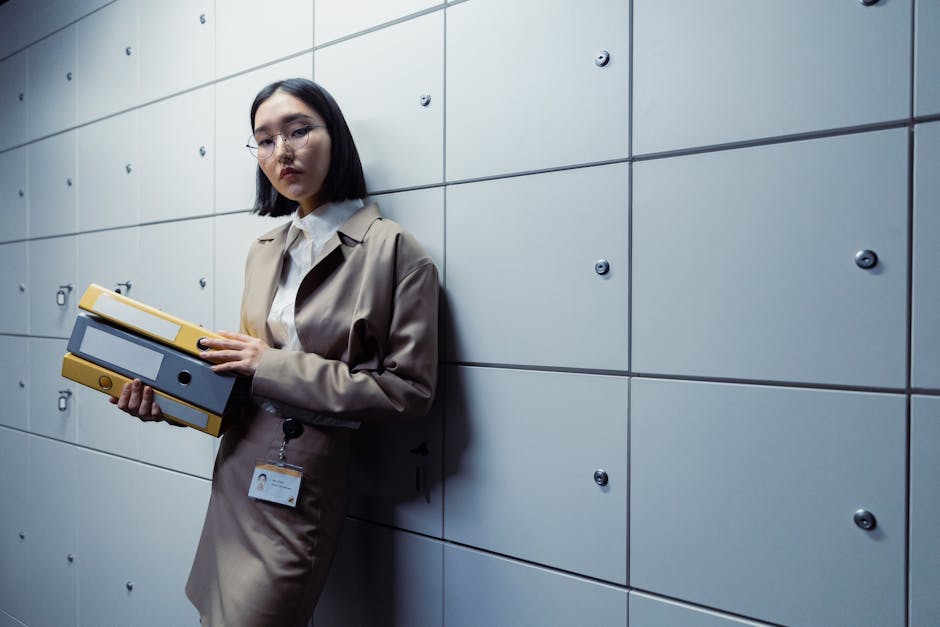
Margaret Finch arrives at the Department of Lost Conversations every morning at 7:23 AM, her coffee still steaming, her badge reading "Senior Archivist, Division of Unspoken Truths." The building itself exists in the space between Monday and Tuesday, accessible only through a door marked "Authorized Personnel" that most people assume leads to a janitor's closet. Margaret has worked here for eleven years, though she can only remember deciding to apply yesterday.
The Department occupies seventeen floors of conversations that were swallowed by hesitation, interrupted by phone calls, or simply dissolved in the moment before courage arrived. Margaret's cubicle sits in Section K: "Things Parents Meant to Say to Their Children." Her neighbor, Harold Wimsey, manages Section L: "Apologies That Got Lost in Traffic."
"Morning, Margaret," Harold calls out, though his voice carries the particular emptiness of words that have been filed away too long. "Got a big shipment coming in today. Three-car pileup on Interstate 94 yesterday. Lot of people didn't get to say goodbye."
Margaret nods and opens her first file. Case #47291: Sarah Chen, age 34, meant to tell her mother about the promotion on Sunday but got distracted by her nephew's birthday party. The conversation sits in its manila folder like a pressed flower, all the joy and pride carefully preserved but never quite blooming. Margaret catalogs the key phrases: "Mom, you were right about the accounting classes." "I wanted you to be the first to know." "I'm finally making enough to pay you back for everything."
Each conversation gets a reference number, a brief summary, and a severity rating. Some are Category 1: minor disappointments that will resolve themselves. Others are Category 5: the kind of silence that calcifies into permanent regret.
By 10 AM, Margaret has processed twelve birthday wishes, four love declarations, and one particularly detailed set of funeral arrangements that got derailed when someone knocked over the coffee pot. She's developing a headache from Case #47304, which contains a thirty-minute monologue about forgiveness that was rehearsed in bathroom mirrors for three weeks but never delivered.
"Finch," her supervisor, Director Pemberton, appears beside her desk. He's a thin man who speaks only in sentences that other people started but never finished. "About the Richardson file—"
"Still processing," Margaret interrupts, because she's learned that with Pemberton, you have to complete the thought or it joins the filing system permanently.
"Right. Well. The thing is—" He pauses, and Margaret watches his words hover in the air like smoke before settling into a pending folder marked "Administrative Loose Ends." Pemberton sighs and walks away, leaving behind the faint smell of unfinished business.
Margaret's lunch break is spent in the Department cafeteria, where the only menu item is "things you meant to ask for but settled for something else instead." She orders the sandwich and receives what looks like regret between two slices of whole wheat. It tastes like Sunday dinners where everyone avoided talking about politics.
Section M adjoins her workspace: "Last Words That Weren't." Through the glass partition, she can see her colleague Dr. Wilhelmina Paradox organizing conversations by date of non-occurrence. Wilhelmina specializes in the theoretical framework of unexpressed sentiment, having written her dissertation on "The Quantum Mechanics of Held Tongues."
"Margaret," Wilhelmina calls out during the afternoon lull, "I'm having trouble with Case #47187. It's a conversation between two people who both wanted to say the same thing but were each waiting for the other to speak first."
"Feedback loop?"
"Worse. It's created a recursive silence that's been generating phantom conversations for six months. I think it might be achieving consciousness."
Margaret looks through the partition at a file that appears to be humming quietly to itself. "Have you tried the standard de-escalation protocol?"
"Twice. It just absorbs the intervention attempts and generates new scenarios. Last week it produced a forty-page dialogue about how they should have handled the original situation."
This is the part of the job that Margaret finds most challenging: the conversations that become self-aware. They start creating their own alternate versions, branching into infinite possibilities of what might have been said. The Department's basement houses an entire wing of conversations that have become so complex they require their own filing system.
At 3:47 PM, Margaret receives an urgent delivery: Case #47351, a conversation between two old friends who spotted each other at a coffee shop but pretended not to see one another due to an unresolved argument from seven years ago. The awkwardness is so thick that Margaret has to open the file with rubber gloves.
"Hey, is that you?" radiates from the folder with the warmth of recognition.
"I thought that was you! How have you been?" responds with equal measures of joy and nervous energy.
"I've missed talking to you," carries the weight of seven years of silence.
"I'm sorry about the thing with the wedding invitation," holds enough regret to power a small city.
Margaret seals the file quickly. Category 5 conversations always make her emotional, and she's learned that tears can damage the documents. She places it in the urgent processing queue, knowing that somewhere in the city, two people are driving home wondering why they couldn't just be brave for thirty seconds.
The day's final case arrives at 4:15 PM: Case #47359, a simple "I love you" that got interrupted by a commercial break during a phone call. The three words sit in their folder like refugees from a better timeline, complete and perfect but displaced. Margaret gives them a Category 2 rating – likely to resolve within the week – and files them under "Telecommunications Interruptions, Romantic Subcategory."
As 5:00 PM approaches, Margaret begins her closing procedures. She locks away the day's unspoken words in the massive filing system that stretches from floor to ceiling. Each conversation will remain here until it either expires from irrelevance or finds its way into the world through some other means – a letter, an email, a moment of unexpected courage.
Harold Wimsey waves goodbye with a gesture that contains at least three different farewells he's never been able to properly express. Dr. Paradox offers a nod that somehow acknowledges the inherent sadness of their profession while also suggesting hope for tomorrow's conversations.
Margaret locks her desk drawer, which contains her own personal file: Case #00001, "Things I Meant to Say to My Mother Before She Stopped Recognizing Me." She's been the Department's first employee, hired specifically because she understood the weight of unspoken words better than anyone. The file has grown thick over the years, filled with conversations that will never find their proper recipient.
She walks through the building's corridors, past Departments of Unmailed Letters, Unexpressed Gratitude, and Theoretical Reconciliations. At the elevator, she presses the button marked "Reality" and waits for the doors to open onto Tuesday evening, where people are finishing conversations they actually started.
As the elevator rises toward the regular world, Margaret touches her coat pocket where she keeps a small notebook. Tonight, she thinks, she might finally write down some of those things she meant to say. Not for the Department, not for filing or cataloging, but for the simple act of letting words exist in the world, even if only on paper.
The elevator doors open onto a street where people are talking to each other – sometimes badly, sometimes beautifully, but actually talking. Margaret steps out into the evening air, surrounded by the sound of conversations in progress, and for once doesn't feel the urge to catalog what's being left unsaid.