
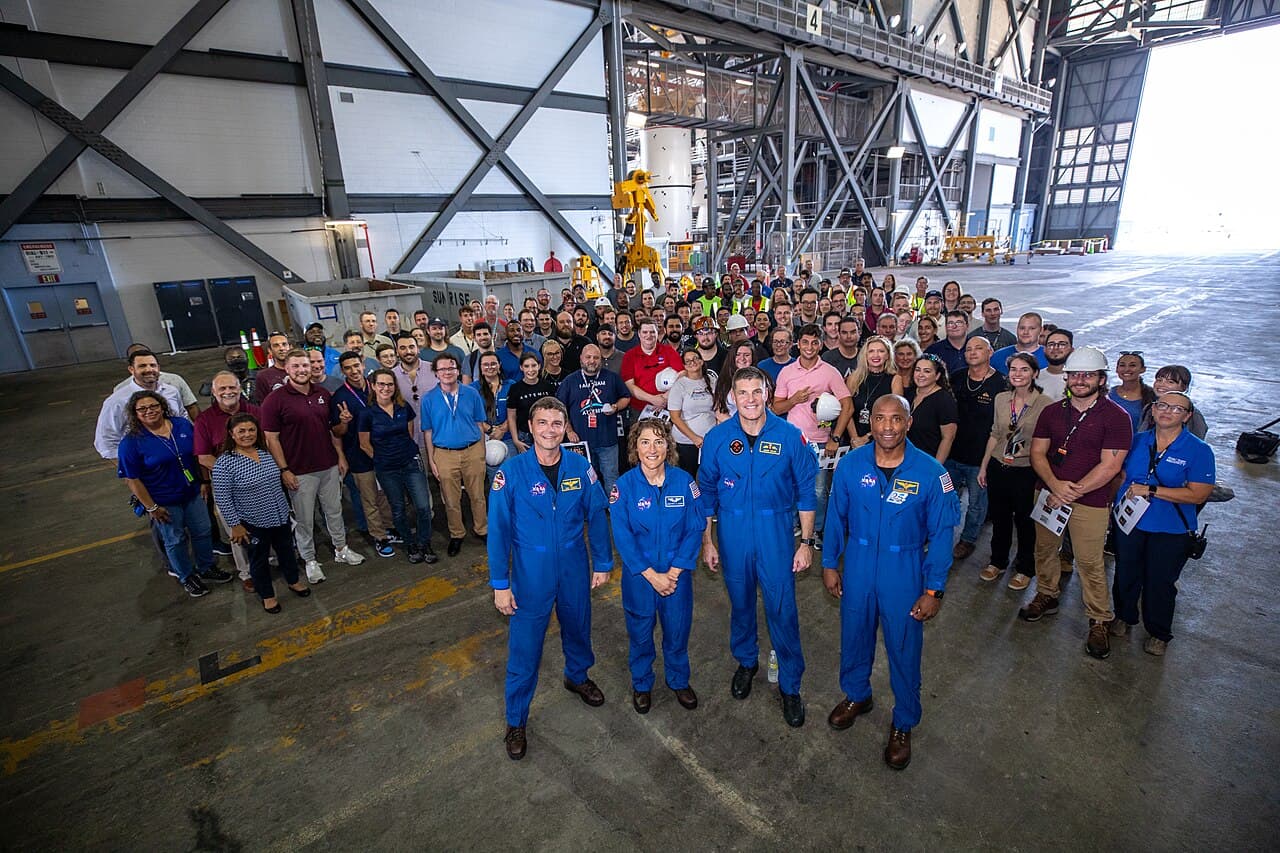
Christina Koch stood before reporters Sunday morning at Kennedy Space Center, reflecting on a journey that will make her one of only 28 humans to ever travel beyond Earth orbit. "Things are certainly starting to feel real," the NASA astronaut said, speaking for the four-person Artemis II crew preparing to break humanity's half-century absence from the Moon.
Koch, along with commander Reid Wiseman, Victor Glover, and Canadian astronaut Jeremy Hansen, will launch Wednesday at 6:24 p.m. EDT aboard NASA's Space Launch System rocket—the most powerful rocket ever successfully flown. Their 10-day mission will take them around the Moon and back, splashing down in the Pacific Ocean as the first crew to leave Earth orbit since Apollo 17 in December 1972.
The crew arrived at Kennedy Space Center Friday afternoon, touching down on the spaceport's three-mile runway in sleek T-38 jets at 2:10 p.m. Eastern Time after flying from Johnson Space Center in Houston. The symbolic arrival marked the beginning of their final preparations for a mission that represents NASA's return to deep space exploration after decades focused on low Earth orbit.
"It is our strong hope that this mission is the start of an era where everyone, every person on Earth, can look at the moon and think of it as also a destination," Koch said during Sunday's news conference, according to the New York Times.
The crew has also selected their zero gravity indicator—a small item that will float freely in the capsule once they reach space, providing a visual confirmation of weightlessness. Commander Wiseman announced Friday that "Rise," designed by Lucas Ye of Mountain View, California, will accompany them on their lunar journey.
According to CBS News, the mission will cover nearly 700,000 miles as the crew first orbits Earth before heading toward the Moon. The flight plan calls for them to loop around the lunar surface without landing, then return to Earth for an ocean splashdown—a trajectory similar to Apollo 8's historic Christmas 1968 mission.
The Artemis II launch comes after NASA's uncrewed Artemis I mission successfully completed the same route in late 2022, though that flight revealed unexpected damage to the Orion capsule's heat shield that engineers have since addressed, NBC News reported.
- Artemis II will test all systems with crew aboard before lunar landing attempts
- A follow-on flight next year will test rendezvous procedures with commercial moon landers
- SpaceX and Blue Origin are building the landers for future surface missions
NASA has scheduled multiple briefings leading up to launch, with a 2 p.m. news conference planned to provide status updates, followed by another at 5 p.m. after mission management meetings. The agency will stream prelaunch, launch, and mission events online throughout the historic flight.
For the four astronauts, the weight of representing humanity's return to deep space is palpable. As they conduct final preparations at Launch Complex 39B—the same pad that sent Apollo missions to the Moon—they're carrying the hopes of a generation that has only read about lunar exploration in history books.
The mission represents more than technological achievement; it signals America's renewed commitment to space exploration beyond Earth orbit, with plans for permanent lunar bases and eventual Mars missions. If successful, Artemis II will pave the way for the first woman and first person of color to walk on the Moon.