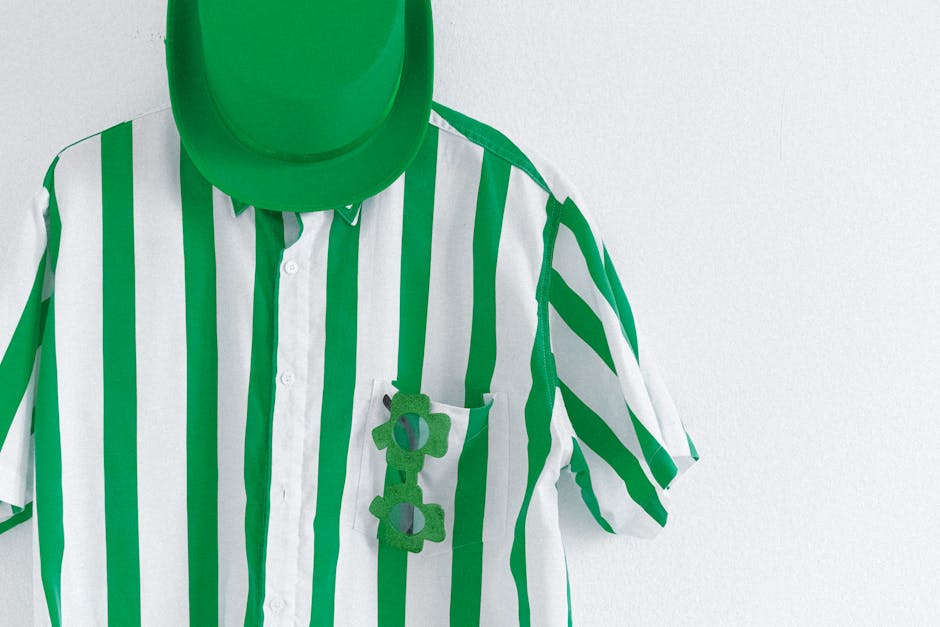
Every March 17th, millions of Americans transform into temporary Irish people, complete with green beer, leprechaun hats, and accents that would make a Dublin native weep. What began as a religious feast day honoring Ireland's patron saint has morphed into something unrecognizable — a carnival of stereotypes that would be considered offensive if applied to any other ethnic group. Yet somehow, when it comes to the Irish, everyone gets a pass.
The numbers tell the story of a holiday spinning out of control. According to the National Retail Federation, Americans spent $6.16 billion on St. Patrick's Day in 2025 — more than Valentine's Day. But dig deeper into what that money bought, and you'll find a troubling pattern: plastic shamrocks manufactured in China, "Kiss Me I'm Irish" t-shirts worn by people whose closest connection to Ireland is a great-grandmother's maiden name, and enough green food coloring to turn the Chicago River emerald for a month.
The transformation didn't happen overnight. Irish-Americans, desperate to assimilate after decades of discrimination, packaged their culture into something palatable for mainstream America. The complex history of colonization, famine, and diaspora got reduced to four-leaf clovers and drinking songs. What was once a solemn religious observance became an excuse for public intoxication.
The Commercialization Machine
Walk into any American bar on March 17th and witness the spectacle: Budweiser dyed green, corned beef and cabbage (a dish more associated with Irish-Americans than actual Ireland), and bartenders wearing plastic bowler hats. The aesthetic is "Irish" in the same way that Taco Bell is Mexican — a vaguely themed approximation designed for mass consumption.
The irony is staggering. Modern Ireland is a tech hub, home to European headquarters for Google, Facebook, and Apple. It's a country that voted to legalize same-sex marriage and abortion, that produces world-class literature and cinema. Yet American St. Patrick's Day imagery remains frozen in 19th-century stereotypes of drunken, superstitious peasants.
Perhaps most telling is what gets left out of the celebration entirely. There's no mention of the Irish language, one of Europe's oldest vernacular languages, now spoken by fewer people than live in Staten Island. No acknowledgment of Irish contributions to literature — James Joyce, W.B. Yeats, Samuel Beckett — that shaped modern writing. No recognition of the complex political history that sent so many Irish people to America in the first place.
The cultural appropriation aspects become clearer when you imagine the equivalent applied to other ethnic groups. Picture "Wear Blackface for Martin Luther King Day" or "Dress Like a Stereotype for Cinco de Mayo" — wait, Americans already do that second one. The pattern reveals something uncomfortable about how ethnic identity gets commodified in America.
The Authenticity Paradox
Irish-Americans find themselves in an impossible position. Criticize the commercialization, and you're accused of gatekeeping. Embrace it, and you're participating in the degradation of your own heritage. Meanwhile, actual Irish people watch from across the Atlantic as their culture gets remixed into something unrecognizable.
"It's like watching someone wear your grandmother's wedding dress to a Halloween party. Technically, it's just fabric and lace, but it feels like desecration." — Siobhan McCarthy, Irish cultural historian
The economic incentives ensure the cycle continues. Bars make 30% of their annual revenue on St. Patrick's Day weekend. Costume manufacturers tool up months in advance. Cities compete for the most elaborate parades, the greenest rivers, the most outrageous displays of synthetic Irishness.
What's lost in all this performative ethnicity is any genuine engagement with Irish culture. How many Americans celebrating St. Patrick's Day have read Irish poetry, learned Irish history, or supported Irish causes? How many know that Ireland was the first country to ban smoking in workplaces, or that it's leading Europe in renewable energy adoption?
- Ireland has produced four Nobel Prize winners in literature — more per capita than any other country
- The Irish language is experiencing a revival, with 1.7 million people now claiming some knowledge of it
- Modern Irish music extends far beyond traditional folk — from U2 to Sinéad O'Connor to contemporary artists like Hozier
- Irish emigration patterns continue today, with young Irish people moving globally for economic opportunities
The tragedy is that there's so much richness to explore beyond the caricatures. Irish traditional music, with its complex rhythms and haunting melodies. Irish literature, from ancient sagas to contemporary fiction. Irish contributions to philosophy, science, and social justice. Irish cuisine that extends far beyond potatoes and includes sophisticated modern interpretations of ancient ingredients.
But complexity doesn't sell beer. Nuance doesn't fit on a t-shirt. And so every March 17th, we get the same tired parade of stereotypes, each year more commercialized than the last, further divorced from any authentic connection to Irish culture or history.
Perhaps it's time to ask what St. Patrick's Day could become if it focused less on performance and more on genuine cultural exchange. What if the holiday celebrated Irish contributions to literature, music, and social progress? What if it became an opportunity to learn about modern Ireland, not just mythological versions of the past?
The saint himself might appreciate the irony. A man who devoted his life to bringing Christianity to Ireland has become the patron of a holiday that celebrates excess. A missionary committed to authentic transformation has become the figurehead for the most inauthentic cultural performance of the year. Even in sainthood, it seems, you can't escape American marketing.